Resume Teardown #111: Mid-Level PM, 82%, Clarify the Claims
This is part of our Resume Teardown series where we score real PM resumes (anonymized) and break down what the evaluation found.
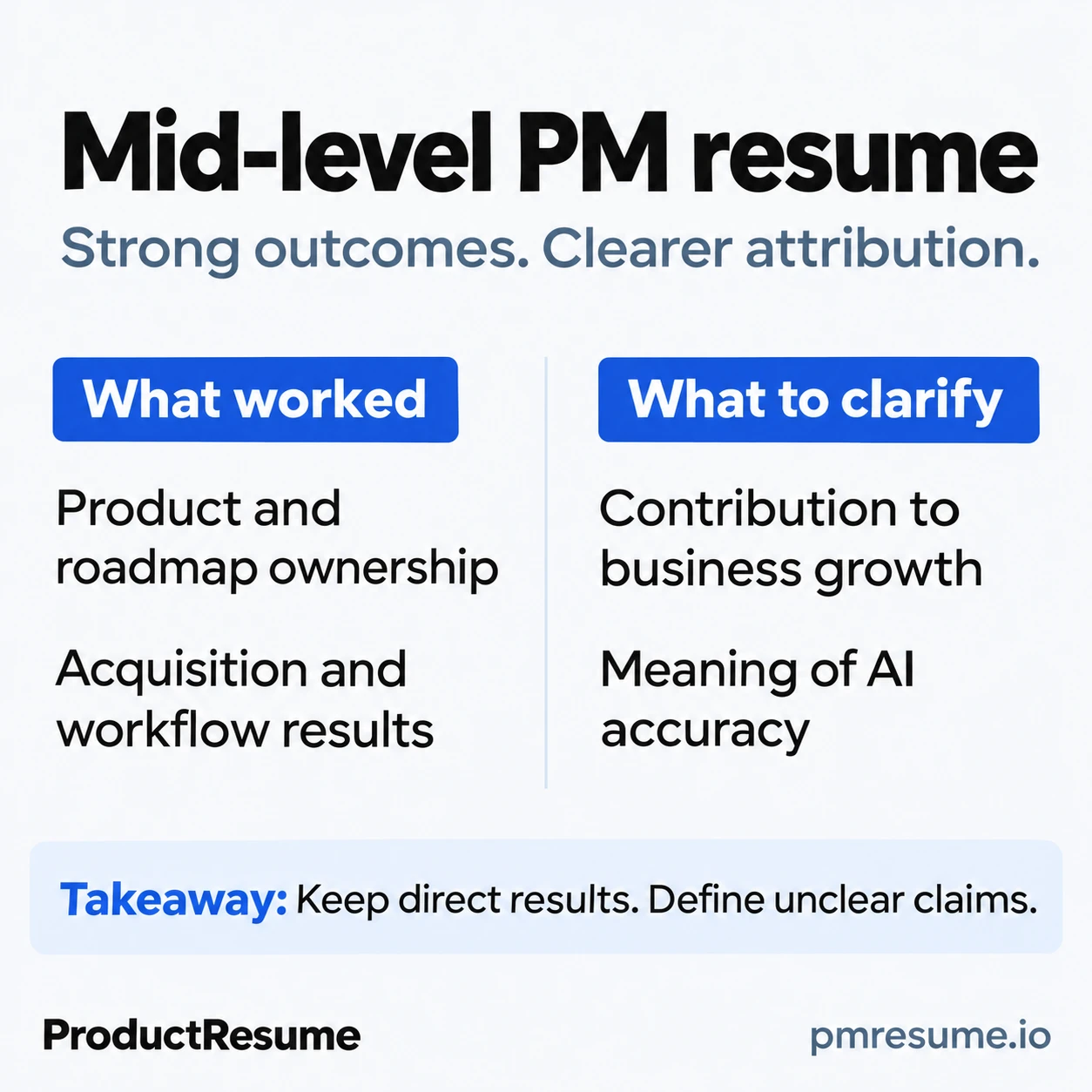
TL;DR: This mid-level product manager resume scored 82%. It demonstrates ownership, discovery, and measurable acquisition and workflow results. The useful next edit is to clarify a few claims while preserving the direct evidence already present.
The Resume
Background: A mid-level individual contributor with an engineering foundation and subsequent product ownership. The resume combines customer-facing growth work with platform improvements.
What looked strong:
- Ownership of product surfaces and roadmaps is explicit.
- Shipped work connects to acquisition, delivery efficiency, and customer outcomes.
- Discovery includes interviews and observation of real workflows.
- Technical decisions support product delivery rather than appearing only in a skills list.
Recorded score: 82%. The report recommends a phone screen for a mid-level IC role. This is a historical evaluation of the supplied resume, not a hiring probability or a new assessment of an edited version.
The calibration separates broader technical experience from product-management experience. That makes the evaluation more useful than treating every year in technology as a year of PM responsibility.
Preserve the Direct Result Before Asking for Another Metric
The acquisition bullet already contains a product-relevant outcome and qualifies its broader business contribution.
Paraphrased finding: A launch improved organic acquisition and generated incremental traffic. The same entry describes a contribution to a larger commercial result.
Those are different claims. Incremental traffic is evidence close to the acquisition work. The broader commercial movement may also reflect pricing, demand, other channels, and changes elsewhere in the customer journey.
The report asks for a more directly attributable result, but it underplays the direct acquisition measure already supplied. A stronger review starts by recognizing that evidence. It then asks whether the relationship to the commercial result is clear enough.
Keep the original contribution qualifier. Replacing it with sole credit would make the statement less trustworthy. If the product's exact share of the wider result is unknown, another revenue figure should not become mandatory.
| Claim | What the resume establishes | Useful clarification |
|---|---|---|
| Acquisition result | A reported increase in traffic connected to the launch | Explain the relevant comparison or measurement period if unclear |
| Wider business growth | A contribution claim, rather than sole ownership | State the supported relationship without claiming the entire result |
| Downstream conversion | Not established by the acquisition figure alone | Include only if separately measured and relevant |
Illustrative fix pattern: "Launched [supported acquisition change], generating [verified direct result] and contributing to [broader outcome, with its actual attribution limits]."
This is a structure, not a replacement achievement. Use it only with facts you can support. If the wider result creates more ambiguity than useful context, lead with the direct acquisition evidence instead.
Explain What AI Accuracy Means
A high accuracy claim becomes more useful when the reader knows what was assessed.
Paraphrased finding: A change to the information supplied to an AI-assisted workflow improved a reported accuracy measure. The resume gives the result without defining the measure or evaluation context.
The work is substantive evidence. It goes beyond listing AI terminology because it connects a technical contribution to an outcome. The unresolved question is what that outcome actually represents.
Was accuracy assessed against expected answers, a review criterion, successful task completion, or another defined standard? The resume does not establish that detail. An editor should ask for it rather than selecting a plausible method.
One short clarification could be enough. You do not need an evaluation report inside the bullet. State the criterion and the most relevant test context, especially if the result came from a bounded evaluation.
Illustrative fix pattern: "Improved [defined quality measure] for [supported workflow], assessed using [actual evaluation method or review criterion]."
If no baseline was recorded, do not invent one. If testing covered a limited set of tasks, preserve that scope rather than implying reliable performance across every use case.
This is a clarity check on an existing claim. It does not mean every general PM resume needs specialized AI safety, model training, or evaluation-platform experience.
Show One Consequence of Discovery
The resume demonstrates discovery activity; one resulting priority would make its value easier to assess.
Paraphrased finding: Stakeholder interviews surfaced platform needs and informed a prioritized roadmap. The bullet names the research activity and planning output, but leaves the selected priority implicit.
That is credible product work. The useful refinement is to show one connection between the needs uncovered and the choice made. The research count alone cannot explain why a particular problem deserved attention.
You could name a priority accepted into the roadmap, a scope change, or a decision to defer something. Use the consequence that actually happened. A roadmap decision can be relevant even when the feature has not shipped.
Illustrative fix pattern: "Used [actual discovery evidence] to prioritize [confirmed need] in the roadmap, addressing [supported problem]."
Keep the person's decision authority accurate. Consulting stakeholders does not establish sole ownership of every resulting priority. Equally, collaborating on a roadmap does not erase a meaningful PM contribution.
The resume already contains other discovery evidence connected to product initiatives. This edit should improve the least clear example, rather than add an interview transcript to every bullet.
Keep the Skills List Proportionate to the Evidence
Technical product credibility is already visible; specialized skills should remain explainable from actual work.
The report distinguishes demonstrated integrations, data work, and product practices from additional specialized methods listed in Skills. That is useful feedback because a list can imply experience the work history does not explain.
For a skill central to your target role, consider whether a concise example would help. If the skill is peripheral or you cannot substantiate its application, trimming the claim may be the better edit.
The goal is not a separate bullet for every tool. Several skills can be supported by one well-described contribution. Avoid making the document longer merely to repeat the vocabulary from its Skills section.
The same restraint applies to positioning. The report itself identifies a coherent thread of technical product ownership and growth. Breadth across customer and platform problems is not inherently a gap. Tailor the emphasis when a target role requires it, without rewriting a coherent career as a weakness.
Dimension Scores
The recorded scores reflect a strong foundation with a few evidence-clarity improvements.
| Dimension | Recorded score | Editorial reading |
|---|---|---|
| Leadership and Impact | 82% | Ownership and direct outcomes are present; clarify the scope of broader business contribution. |
| Experience and Background | 84% | The engineering-to-product progression supports mid-level IC screening. |
| Domain Expertise | 78% | Applied growth and platform knowledge are visible; role-specific emphasis is optional. |
| Skills and Tools | 81% | Technical product work is substantiated; explain or trim specialized claims selectively. |
The supplied weights produce 81.60, rounded to 82. These are the original evaluation scores. No edited resume was rescored, and the numbers do not predict an employer's decision.
ATS Readiness: 98%
The supplied text is readable; unfamiliar abbreviations are the main clarity check.
The report finds standard headings, consistent employment-date formatting, and coherent associations between entries and bullets. It identifies no material spelling issue in the extracted text.
Expand specialized growth-marketing and testing abbreviations once if your intended reader may not know them. Keep abbreviations that are familiar and useful in the target role. Adding more keywords is not a substitute for clear evidence.
This review assesses the supplied text, not the original visual layout. Check the final export's reading order and spacing separately. A high readiness score does not certify how every employer's screening system will process it.
Key Takeaways
- Credit evidence that is already there. A direct acquisition outcome deserves recognition. Clarify its relationship to broader growth before demanding another metric.
- Preserve honest attribution. A contribution can be meaningful without sole credit for a business result. Keep qualifiers that accurately describe the work.
- Define an ambiguous quality claim. Explain what accuracy measures and how it was assessed. Keep bounded test results within their actual scope.
- Connect discovery to one decision. A priority or scope change makes research more interpretable. It need not imply a shipped outcome when the work remains in planning.
- Edit for relevance, not completeness. Support the skills that matter and clarify unfamiliar terms. A strong resume does not need every possible improvement or process label.
The Pattern
This is a mid-level PM resume with demonstrated ownership and outcomes that need selective clarification. Preserve its direct results, define the ambiguous quality measure, and keep broader business claims within their supported scope. The strongest revision makes existing evidence easier to trust.
Score your own resume to see how your product manager resume performs across all four dimensions.