Resume Teardown #109: Student PM, 79%, Judgment Before Traction
This is part of our Resume Teardown series where we score real PM resumes (anonymized) and break down what the evaluation found.
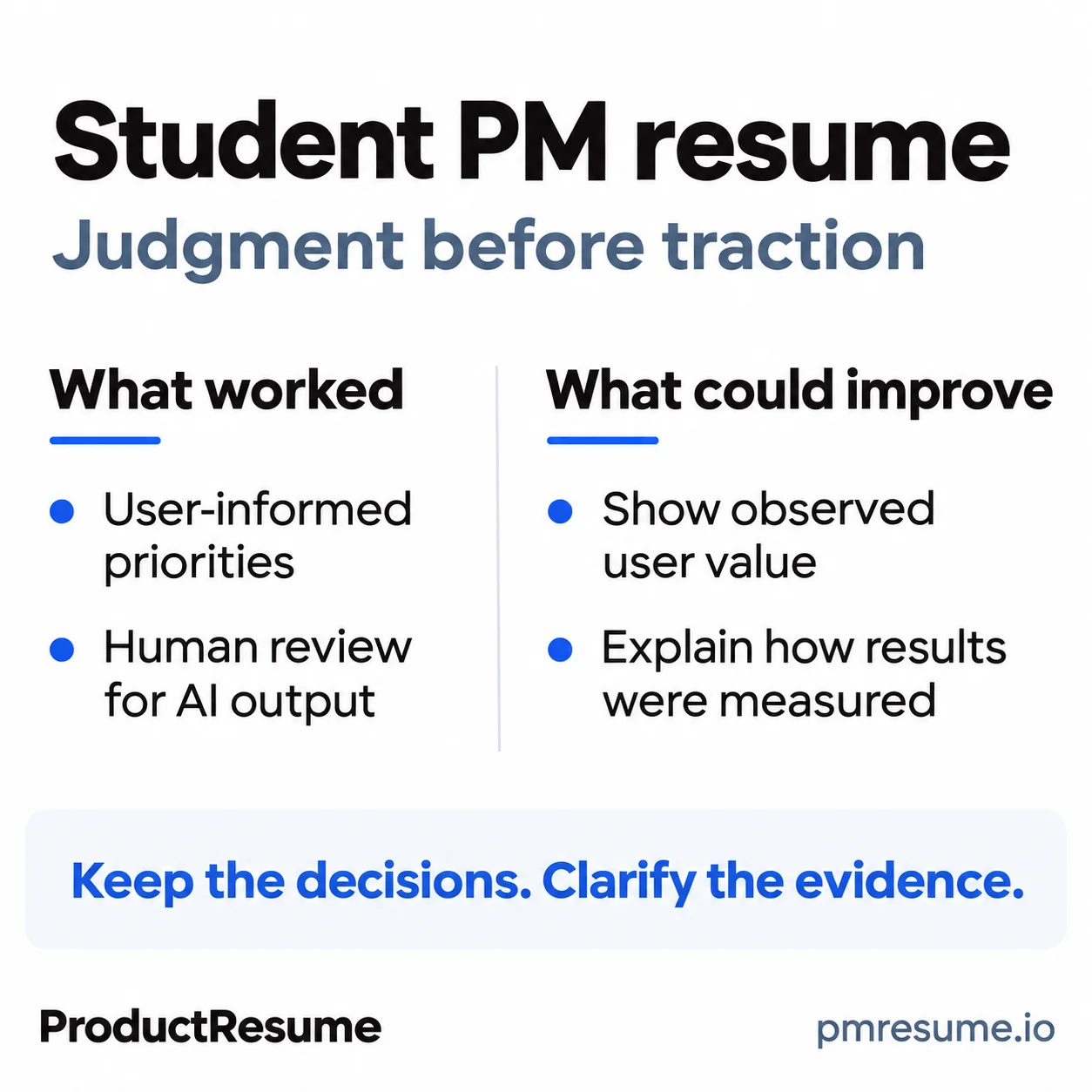
TL;DR: This undergraduate product manager resume scored 79%. It already shows user-informed choices, hands-on delivery, and a thoughtful safeguard for an AI-assisted workflow. The most useful improvement is to show what users valued and explain the basis of a few outcome claims.
The Resume
Background: An undergraduate applying for early product roles, with student-led product work and software delivery experience. The relevant story is the ability to understand a problem, make a choice, and build something usable.
What looked strong:
- User feedback informs requirements and feature priorities.
- A human-review boundary shows deliberate attention to trust.
- Technical delivery is connected to practical workflow problems.
- The resume considers both solution quality and operating cost.
Recorded score: 79%. This is the historical Quick evaluation, not a fresh assessment or an employer's hiring decision. Its student calibration matters: the resume should establish early product potential without borrowing expectations from an experienced PM role.
Product Judgment Is Already Visible
This resume needs to preserve its decisions, not replace them with a longer list of methods.
Paraphrased finding: In an AI-assisted workflow, the student kept a person responsible for reviewing the output before an external action. Elsewhere, user feedback informed a feature priority.
These examples demonstrate more than the ability to build. They show a boundary on automation and a reason to choose one improvement. Both are useful evidence for an associate product manager application.
The recorded report recognizes requirements, user feedback, research, and trade-offs. Its recommendations should build on that evidence. Asking this student to add discovery everywhere would overlook work already represented in the resume.
You can make one decision easier to understand without turning the bullet into an interview transcript. Name the problem, the choice, and the relevant consequence. Reserve the full discussion of alternatives for the interview.
Illustrative fix pattern: "Kept [confirmed action] under human review to address [supported concern], while automating [appropriate supporting task]."
This is a structure for describing a real decision. It does not establish that the safeguard improved trust, prevented errors, or increased use. Those would need separate evidence.
The strongest next edit might be one clarifying phrase rather than a completely rewritten section. Keep the student's actual contribution and avoid inflating collaborative delivery into sole ownership.
Low Operating Cost Does Not Establish User Value
An efficiency measure answers a different question from a user-quality measure.
Paraphrased finding: The student venture tracks processing cost and names a quality measure, but the resume does not give a clear observed quality result or user response.
Cost awareness is a strength. It suggests the builder considered whether the workflow could be operated sensibly. Yet an inexpensive output can still be irrelevant or difficult to use.
The report's most useful follow-up is therefore narrow: what did a user do with the output, or what did a quality review reveal? A documented piece of feedback, an observed correction, or a clearly defined evaluation result could help.
If the project is still being piloted, state that stage. A target is useful as a target; it should not be presented as an achieved outcome. Similarly, naming a metric does not establish that the metric improved.
| Evidence | What it can support | What still needs evidence |
|---|---|---|
| Processing cost | Awareness of operating efficiency | Whether the output helped a user |
| Defined quality measure | An evaluation plan | The observed result and its basis |
| User feedback | A learning signal | Whether a change solved the reported issue |
For an early product, qualitative learning can be enough to strengthen the story. There is no need to invent retention or revenue merely because the resume contains a founder title.
Make Improvement Claims Interpretable
A measured improvement is stronger when the reader understands what was compared.
Paraphrased finding: A project claims better output quality and less manual effort, but the resume leaves the evaluation method unclear.
The recorded report asks what quality meant and which comparison supported the time-saving claim. Those questions improve credibility without dismissing the work.
Was the comparison against a previous version, a manual task, or another baseline? Did the result come from a bounded test or normal use? The resume does not need every experimental detail, but it should make the nature of the evidence legible.
Illustrative fix pattern: "Evaluated [output] against [actual baseline] using [defined criterion], observing [supported result] in [test or use context]."
Use only details the student can substantiate. If the result came from a project evaluation, say so. A prototype test should retain its actual scope rather than imply sustained production performance.
The public lesson does not depend on reproducing the original work figures. It depends on the distinction between a confident claim and an understandable measurement.
The same principle applies to workflow improvements. Explain the manual step that changed before asking the reader to accept a broad efficiency conclusion.
Clarify Context Without Adding Resume Homework
Make existing experience easier to interpret before adding more content.
The report notes that concurrent entries could use an accurate context cue. If a role is student-led or part-time, label it accordingly. Do not infer a working arrangement from the dates alone.
A second recommendation concerns skills that are named more clearly than they are demonstrated. The remedy is selective: connect an important claimed practice to work already done, or remove a claim the student cannot explain.
This does not mean every tool deserves a bullet. A resume is a shortlist document, not an inventory of evidence for every keyword. One clear priority decision can be more useful than several added process labels.
For technical work, introduce the user or workflow in plain language. Internal system names are rarely the strongest way to explain why an integration mattered.
Dimension Scores
The original evaluation gives the most weight to demonstrated skills at this career stage.
| Dimension | Recorded score | Editorial reading |
|---|---|---|
| Leadership and Impact | 76% | Ownership and trust decisions are visible; observed user response would strengthen them. |
| Experience and Background | 78% | Relevant student and delivery experience; clarify concurrent arrangements only where accurate. |
| Domain Expertise | 78% | Applied workflow knowledge is present; plain-language user context would improve accessibility. |
| Skills and Tools | 80% | Technical execution and product practices are demonstrated; keep the skills list proportionate to evidence. |
The supplied weights produce 78.9, rounded to 79. These scores describe the recorded evaluation, not hiring probabilities or a predicted score after editing.
ATS Readiness: 90%
The extraction is mostly readable, with a few boundaries worth checking in the final export.
The report finds standard headings and consistent dates. It flags unexplained internal abbreviations and adjacent fields that run together in the extracted text.
Check the exported document by copying its text into a plain-text editor. Confirm that headings, dates, and bullets remain associated with the correct entries. Adjust spacing or layout if the problem persists.
This is an extraction check, not a visual inspection of the original file. The score does not establish that every employer's screening system will interpret the resume identically.
Key Takeaways
- Keep the decisions already present. A user-informed priority and an intentional automation boundary are useful early PM signals. Explain them clearly before adding more vocabulary.
- Separate operating efficiency from usefulness. Low cost helps assess viability. Add a supported quality result or user response to explain value.
- Give outcome claims a measurement context. State what was compared and how the result was assessed. Preserve the distinction between a test and ongoing use.
- Describe early work at its real stage. A pilot can show judgment and learning. It does not need invented commercial traction to earn space.
- Use small clarifications where they solve the problem. An accurate arrangement label or a plain-language workflow description can reduce ambiguity. More bullets are not automatically better.
The Pattern
This is a student builder resume with visible product judgment and incomplete outcome context. The strongest revision connects those existing decisions to observed learning or bounded results. Keep the early-career scope honest and make the evidence easier to understand.
Score your own resume to see how your product manager resume performs across all four dimensions.