Resume Teardown #110: Engineer to PM, 63%, Make Learning Visible
This is part of our Resume Teardown series where we score real PM resumes (anonymized) and break down what the evaluation found.
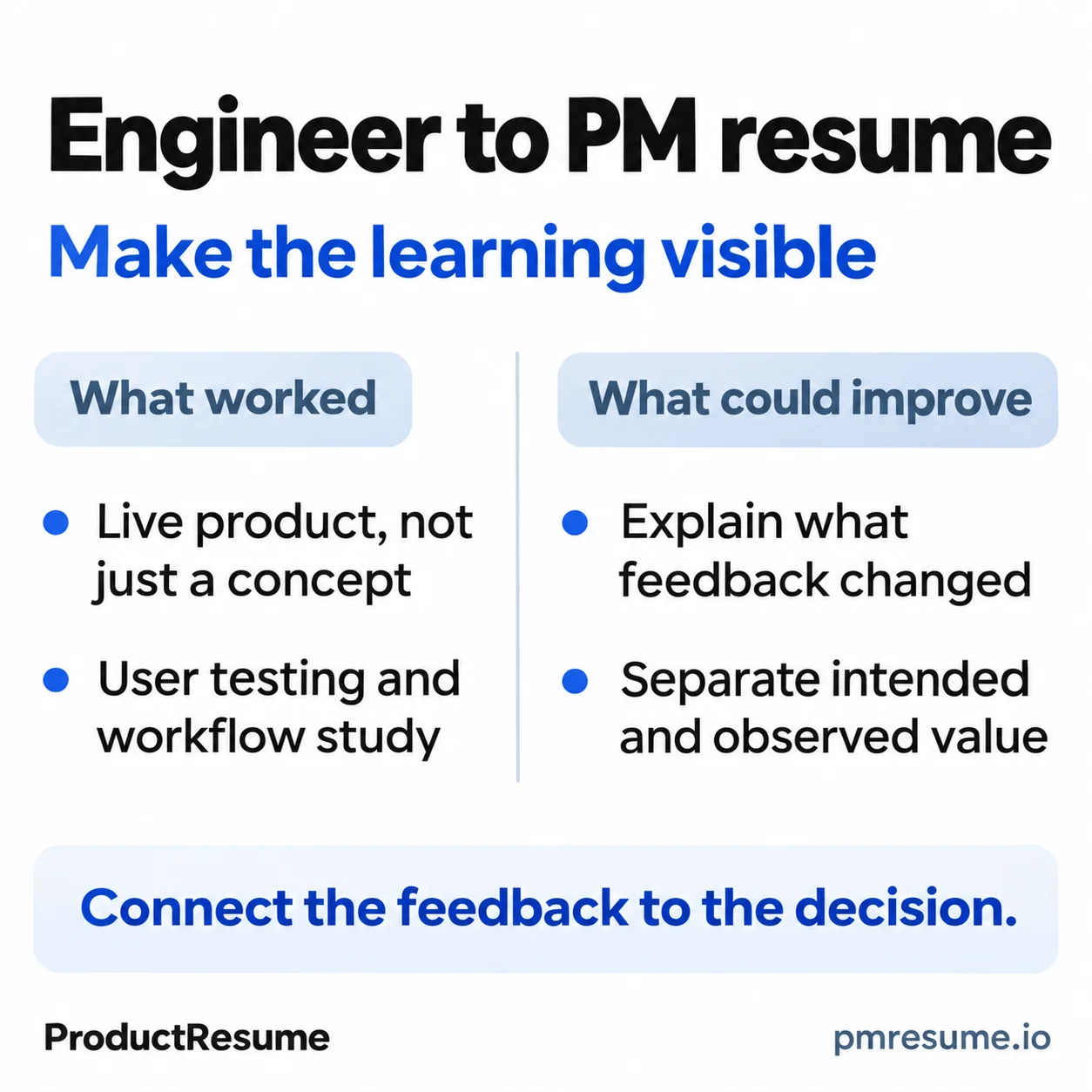
TL;DR: This engineer-to-product-manager resume scored 63%. Internal tools and an independently built live product provide credible starting evidence. The opportunity is to connect existing user testing and workflow investigation to a specific choice and an observed result.
The Resume
Background: An early-career software engineer seeking an associate product role. The resume combines internal workflow tools with an independent consumer product.
What looked strong:
- A live product shows initiative beyond a written concept.
- User testing and feedback-led iteration are explicitly mentioned.
- Workplace experience includes investigating a manual process before automating it.
- Technical delivery provides a credible base for product roles involving complex workflows.
Recorded score: 63%. This is the historical Quick evaluation, calibrated to an adjacent-career transition. It is a reading of the resume's evidence, not proof that the person lacks product ability.
The Product Work Is There, but the Learning Is Hard to See
The resume already mentions user testing; the missing detail is what that testing changed.
Paraphrased finding: The candidate built a consumer tool, watched people use it, identified gaps, and iterated from their feedback. The resume does not describe a specific observation or resulting change.
That is more useful than a feature list alone. It demonstrates an attempt to learn from users after building. The recorded report recognizes the initiative, although some of its broader criticism risks making the product evidence sound entirely absent.
The right follow-up is concrete: what did a user struggle with, and what changed as a result? One answer could connect the existing testing activity to judgment.
Illustrative before: "Tested the product with users and improved it from feedback."
Illustrative after: "Observed [specific difficulty] during user testing, changed [actual part of the workflow], and saw [supported follow-up observation]."
These are illustrative structures, not quotations or additional achievements. If there was no follow-up observation, retain the actual change and leave the result open.
A small usability finding can help. The candidate does not need commercial-scale adoption to demonstrate early product learning. Equally, a live link alone does not establish that people returned, completed the task, or benefited from the product.
Connect Workflow Investigation to the Automation Choice
Studying a manual process is relevant product evidence when the resulting choice becomes visible.
Paraphrased finding: At work, the engineer examined a time-consuming internal workflow and began developing automation. The description stops before explaining the chosen intervention and its basis.
This is a useful starting point for a transition resume. It suggests the candidate looked beyond implementation instructions and examined how work happened.
The next detail should identify the bottleneck and the part selected for automation. If the candidate contributed to a shared decision, describe that contribution accurately. Do not upgrade participation into ownership of the whole roadmap.
| Current evidence | Useful clarification | Claim to make only if verified |
|---|---|---|
| Manual workflow investigated | Which step caused difficulty | The candidate personally discovered the issue |
| Automation being developed | What is being automated and why | The work is deployed |
| Intended efficiency benefit | How success will be assessed | A measured reduction in effort |
The original report allows an expected or measured improvement. Keep those categories separate. An intended benefit can explain the rationale, but it should not read as an achieved result.
If the work remains in development, describe the confirmed problem, chosen scope, and current stage. That is more informative than assigning a speculative efficiency percentage.
Keep Technical Substance and Add the User Context
Technical implementation becomes easier to assess when you explain the workflow it supports.
Paraphrased finding: An internal tool brings operational information together, but the bullet emphasizes integrations more than the task those integrations help someone complete.
The user group is already partly identified in the source. The improvement is not simply to add a user label. It is to clarify which difficulty the combined information addresses.
For example, a tool might support investigation, monitoring, or another operational task. The candidate needs to supply the actual task; the editor should not choose one because it sounds plausible.
Illustrative fix pattern: "Integrated [supported information sources] into [internal tool] for [actual users], helping them [verified workflow benefit]."
If the benefit has not been observed, describe the tool's intended task rather than claiming that users became faster or more effective.
Keep the technical detail that demonstrates the nature or complexity of the contribution. Remove internal labels that require employer-specific knowledge without helping the reader understand the work.
This is reframing existing experience. It does not require changing the person's engineering title or implying they held a formal PM position.
Give the Independent Product Enough Weight
The strongest transition evidence deserves enough space to explain one complete learning loop.
The independent project establishes a user problem, a working solution, and testing. Those are directly relevant to an early product application.
Consider whether older implementation details can be shortened to make room for the most useful observation, decision, or result. This is an editorial choice, not a rule that projects must always come before employment.
The record does not establish sustained product-management responsibility merely because the candidate describes founder initiative. Keep the actual scope clear and evaluate the demonstrated decisions rather than awarding or discounting experience based on a label alone.
The skills list can support that story. User testing is already demonstrated and can be named. Add requirements definition or prioritization only if the work supports those practices.
Do not turn the report's keyword suggestions into a vocabulary exercise. The word "prioritization" is less valuable than an understandable example of choosing what to address next.
Dimension Scores
The recorded gap is strongest in visible impact, not technical credibility.
| Dimension | Recorded score | Editorial reading |
|---|---|---|
| Leadership and Impact | 58% | Initiative is visible; the effect on users or operations needs clearer evidence. |
| Experience and Background | 72% | Engineering and independent building form a credible transition story. |
| Domain Expertise | 69% | Applied context exists; explain one actual constraint or product consideration where relevant. |
| Skills and Tools | 63% | Technical delivery is strong; connect existing testing and investigation to decisions. |
The supplied weights produce 63 exactly. These historical model scores do not establish the quality of the live product or predict an employer's decision.
The report's technical-product suggestions are reasonable possibilities. They are not evidence that the candidate should apply only to technical PM roles.
ATS Readiness: 70%
Inspect the actual extraction instead of treating every formatting warning as established fact.
The report finds clear headings and consistent dates. It flags an unexplained operational acronym, repeated project links, and isolated empty-parenthesis fragments.
Repeated links are visible in the supplied text. The exact empty-parenthesis fragment described by the report is not apparent in the stored source reviewed here. That makes it a check to perform, not a defect to confidently repeat.
Copy the final export into plain text and inspect reading order and link labels. Use one clear label per destination and expand an unfamiliar acronym if the target audience needs it.
The report also suggests product terms. Add them only when supported, and prioritize a useful statement about the work over keyword insertion. This review did not inspect the original visual layout or test an employer's screening software.
Key Takeaways
- Credit the product practices already present. User testing and feedback-led iteration are meaningful starting evidence. Show what they changed rather than pretending discovery is absent.
- Connect investigation to a choice. Explain the workflow bottleneck and the intervention selected. Preserve the person's actual decision authority.
- Separate current work from completed impact. Development-stage automation can show judgment. Intended benefits must remain distinct from observed outcomes.
- Explain the user task alongside the implementation. A concise workflow description makes technical work easier to assess. Keep useful technical substance.
- Verify automated feedback against the source. Repeated links and an alleged extraction fragment are different claims. Check each before editing the document.
The Pattern
This is a technically credible transition resume whose product learning is underexplained. The strongest revision makes an existing feedback loop and an actual workflow decision visible. It preserves engineering titles, honest project stages, and the boundary between intended value and demonstrated results.
Score your own resume to see how your product manager resume performs across all four dimensions.