How to Tailor a Product Manager Resume to One Job Description
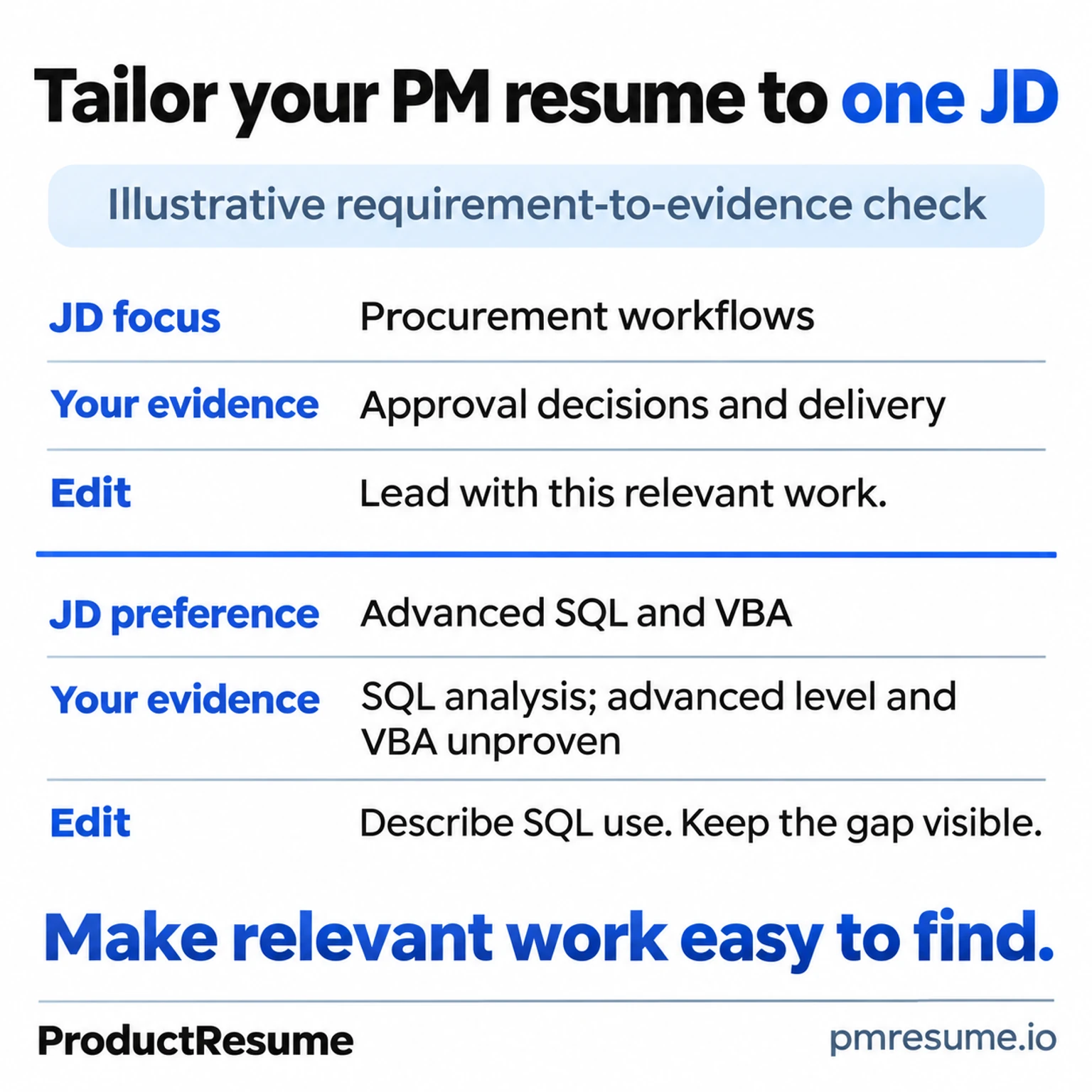
To tailor a Product Manager resume to one job description, make the relevant work easy to find and explain. Ask AI to map the JD to your evidence, revise the passages that need it, and leave you a short list of unresolved gaps.
You can start with your existing resume and rough project notes. You do not need to rewrite your career history before making one useful application.
TL;DR: Compare the role's requirements with evidence from your resume and notes. Clarify supported matches, explain partial matches, and keep missing capabilities visible. The worked example below follows one current PM posting through that review, including what to rewrite and what to leave alone.
Start with one role and one short prompt
Give AI the actual posting, your resume, and any facts the resume leaves out. Remove confidential details before pasting them into a tool.
Tailor my PM resume to this JD. Map the important requirements to evidence in my resume and notes, marking supported, partial, or missing. Revise only passages that benefit from tailoring and explain the changes. Ask one essential question if needed; keep contribution, figures, and project stage accurate. Resume, notes, JD: [paste].
Review the evidence map before accepting the rewritten resume. The important distinction is between a capability that needs clearer wording and a capability you have not yet demonstrated.
If you are still choosing a role family, use the 10-JD method to compare opportunities first. This guide covers one application after you have selected a posting.
Worked example: an enterprise procurement PM role
The job description is real; the applicant and all applicant figures below are fictional. This is an editorial demonstration, not a live prompt test or an employer's assessment.
The Amazon Business India Product Manager posting, job 10533854, checked on 18 November 2026, describes enterprise procurement and customer purchasing journeys. It includes approval workflows among the product areas discussed.
Its basic qualifications include at least two years of PM experience, experience managing technical products or online services, and cross-functional delivery of major new products or services. Preferred qualifications include advanced SQL and VBA, plus cost/benefit and business-case work.
Keep those categories separate. A product area mentioned in the description, a basic qualification, and a preferred skill do not all make the same claim about eligibility.
The fictional resume and supporting notes
The applicant has three years of PM experience at a B2B software company. Their first year focused on service workflows; the next two focused on purchase requests and approvals for business customers.
Their current resume contains these lines:
Product Manager | B2B software company
- Managed the roadmap and delivered workflow improvements.
- Improved approval completion by 20%.
- Maintained a release checklist.
Skills: SQL, Excel, Jira.
The supporting notes add the missing detail:
- Six purchasing administrators described difficulty identifying who needed to approve a request. The PM reviewed that feedback and prioritized approver-status visibility ahead of extra export options.
- The PM defined requirements and coordinated engineering, design, and a finance-operations partner through release of the approval workflow. The notes do not describe a separate major new product launch.
- The PM used SQL to compare requests approved within seven days: 75 of 150 in an earlier cohort, then 90 of 150 after release. Customer mix differed between the cohorts; no controlled test was run.
- The applicant uses SQL for this analysis and Excel for reporting. Advanced SQL, VBA, and a formal cost/benefit business case are not established in the notes.
- The release-checklist line is accurate. No additional achievement is supplied for it.
These are enough facts for a useful first pass. A longer list of adjectives would add little.
Map the job description to the resume evidence
Keep a concrete reason beside each match. “Strong fit” alone does not tell you what the rewritten resume should contain.
| Selected JD requirement or responsibility | Evidence in the fictional notes | Treatment |
|---|---|---|
| At least two years of PM experience, basic qualification | Three years of PM experience | Supported for this stated duration |
| Managing technical products or online services, basic qualification | PM responsibility for a B2B software workflow | Relevant supported experience to make visible |
| Cross-functional delivery of major new products or services, basic qualification | Coordinated an approval-workflow release across functions | Partial: the notes establish bounded delivery, while major-new-product scope needs clarification |
| Enterprise procurement and purchasing journeys, role context | Purchase requests, approvals, and feedback from purchasing administrators | Emphasize this relevant work |
| Advanced SQL and VBA, preferred qualification | SQL analysis is supplied; level and VBA are not | Partial: describe actual SQL use, without adding advanced proficiency or VBA |
| Cost/benefit scenarios and business cases, preferred qualification | No example supplied | Missing evidence; leave it on the gap list |
The map does not establish that the applicant meets every qualification. It shows which facts can improve the application and which questions remain.
One useful question: Did you lead delivery of a new product or service beyond this workflow, and what was your responsibility? A confirmed answer could address a basic-qualification ambiguity. Rewording the feature as an enterprise-wide transformation would not answer it.
Rewrite the relevant passages
Lead with the work most closely connected to the target role. In this example, that means procurement users, approval decisions, cross-functional delivery, and measurement.
A revised experience section could read:
Product Manager | B2B software company
Product scope: purchase-request and approval workflows for business customers.
- Prioritized approver-status visibility ahead of additional exports after reviewing feedback from six purchasing administrators.
- Defined approval-workflow requirements and coordinated engineering, design, and finance operations through release.
- Used SQL to measure seven-day approval completion at 50% before and 60% after release, across 150 requests per cohort; noted different customer mixes when interpreting the comparison.
The first two bullets clarify the work behind a generic roadmap statement. The third replaces an ambiguous percentage with an inspectable measure.
If a summary helps explain the application, it could say:
PM with three years of B2B software experience, including two years on purchasing and approval workflows. Experience spans customer feedback, feature prioritization, cross-functional delivery, and SQL-based measurement.
A summary is optional. Keep it only if it helps the reader understand the relevant thread without repeating the experience section.
Check the figure before accepting the result
The observed rates are 50% and 60%, a difference of 10 percentage points. Relative to the earlier 50%, the difference is 20%. Those descriptions are mathematically different.
| Check | Result from the fictional notes |
|---|---|
| Earlier rate | 75 ÷ 150 = 50% |
| Later rate | 90 ÷ 150 = 60% |
| Percentage-point difference | 60% minus 50% = 10 points |
| Relative difference | 10 ÷ 50 = 20% |
| Attribution | Customer mix also differed; the comparison does not isolate the feature's effect |
The initial “improved approval completion by 20%” hides the measure and suggests causality the notes do not establish. The revised version makes the observed result understandable.
Decide what to leave alone, shorten, or omit
Tailoring does not require changing every sentence. Spend attention where it improves the reader's understanding of relevant work.
The accurate release-checklist line can stay unchanged if it helps explain responsibility. If space is tight, shorten or omit it in favor of the stronger procurement evidence. Do not turn it into launch leadership or a measured efficiency gain without more facts.
The applicant's SQL belongs in Skills and is more informative when demonstrated in experience. The JD's VBA preference stays off the skills list until the applicant has that capability. An unfamiliar term is a question to investigate, rather than text to insert automatically.
You can use three edit decisions:
- Clarify: relevant evidence exists, but the reader cannot see its meaning.
- Keep: the passage already explains useful work clearly.
- Cut or shorten: it adds little for this application and takes space from stronger evidence.
A genuine gap remains a gap after an elegant rewrite. Use it to decide whether to seek clarification, build experience, or prioritize a different opportunity.
Review the application version
Compare the revised resume with both the JD and your source notes. A useful final check takes a few focused questions:
- Can you explain the evidence behind each important requirement the resume now addresses?
- Are the user, your contribution, the release stage, and any figures accurate?
- Are required and preferred qualifications still distinguished?
- Did any unknown capability appear in the skills list or summary?
- Is there useful original content that the rewrite unnecessarily changed or removed?
Save this copy with the role or company so you can return to it before an interview. The tailored resume and your later explanations should describe the same work.
Move from fit feedback to a reviewed application
Prepare a version you can confidently review and send. ProductResume's Job Fit Check compares your resume with a target JD. Use Tailor Resume to adapt the relevant wording, then review the revised copy and remaining gaps against your actual experience. Save the version you want to use. See the fit-to-tailoring workflow.
Related resources
- PM resume examples by level helps you compare scope and responsibility.
- Product Owner to PM resume demonstrates bounded product decisions and delivery.
- Walk me through your resume: PM answer examples helps you explain the application you send.