Product Owner to Product Manager Resume: Beyond the Backlog
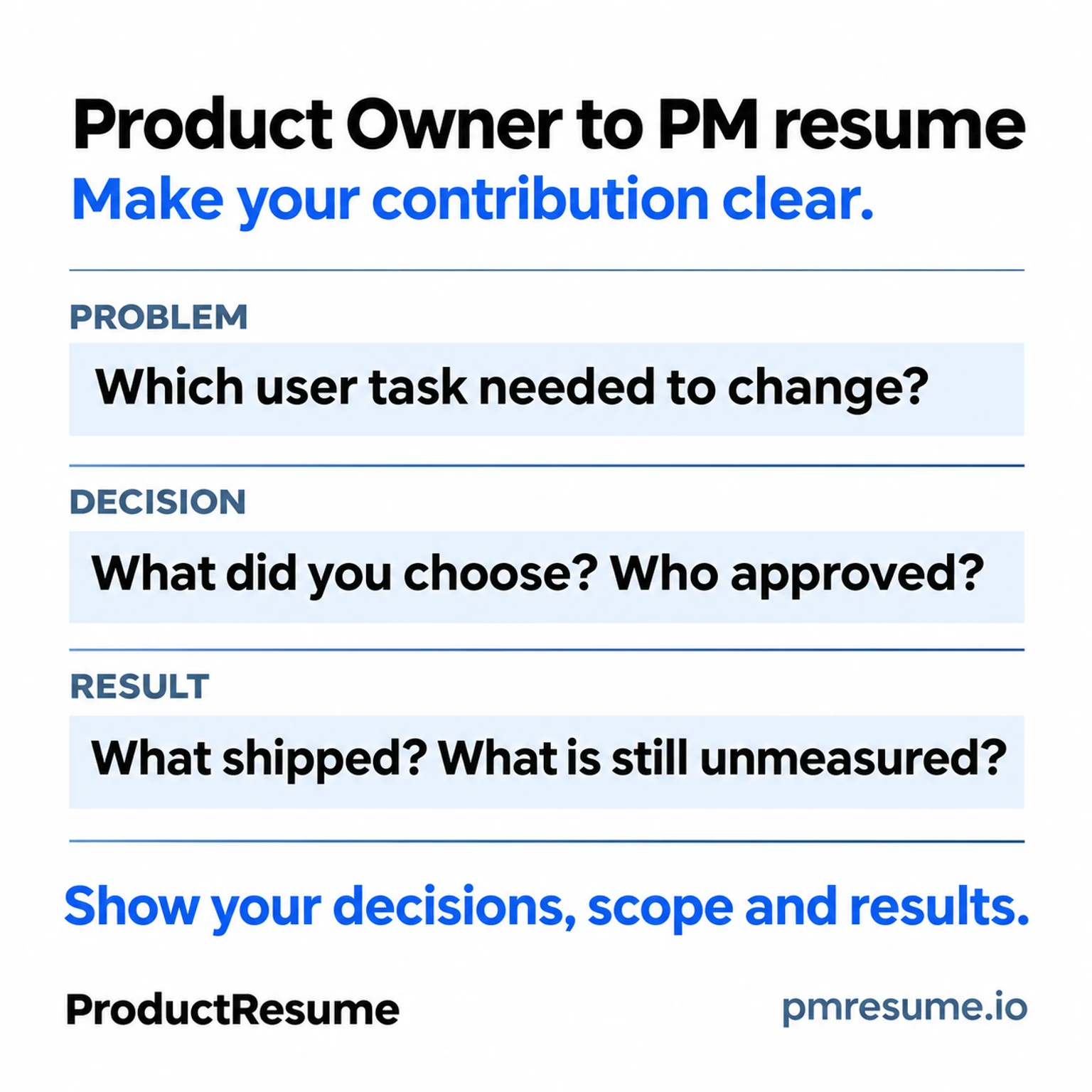
Your Product Owner to Product Manager resume should explain which product problems you helped solve and which decisions were yours. Start with one initiative and make your responsibilities, product choices, and results easy to understand.
TL;DR: Product Owner experience can already include product goals, customer understanding, prioritization, and outcomes. Show the responsibilities you actually held, then compare them with the target PM job. Use AI to make supported evidence clearer; keep someone else's decisions and unmeasured results out of your claims.
Does moving from Product Owner to PM require different experience?
The target responsibilities matter more than a blanket distinction between the titles. Some Product Owners choose problems and shape direction. Others work within priorities agreed elsewhere. Your resume needs to show where your own role sits.
The official Scrum Guide makes the Product Owner accountable for product value, the Product Goal, and effective backlog management. It does not define the role as only writing tickets or attending ceremonies. The guide also recognizes that how the work happens varies across organizations.
Use that distinction when reviewing an AI draft. Replacing “managed backlog” with “owned product strategy” adds a responsibility unless your notes establish it. Keeping only ceremonies can hide genuine product decisions you did make.
A recognizable role label can help explain an opaque internal title. For example, “Consultant II” may say little about a role that involved owning support-portal priorities and requirements. “Product Owner, Support Portal” can describe that function more clearly when it matches the work.
A PM role can also require broader scope than your current work. Compare those responsibilities with the evidence you can show.
Build your Product Owner to Product Manager resume from one initiative
Write a few rough notes before asking for a polished rewrite. You need the facts behind the work, rather than a longer list of product vocabulary.
| Question | Useful evidence | Keep this boundary clear |
|---|---|---|
| What problem mattered? | A user task, support pattern, operational constraint, or customer request | A request is not automatically validated demand |
| What informed the choice? | Feedback, workflow observation, usage evidence, or a known dependency | Do not add interviews you never conducted |
| What did you decide? | A priority, scope cut, requirement, or release condition | Separate recommending, choosing, and approving |
| What reached users? | A prototype, pilot, limited release, or broader rollout | A pilot is not a company-wide launch |
| What happened afterward? | Observed behavior, specific feedback, a measured outcome, or an unresolved question | Delivery alone does not prove improved retention or revenue |
You do not need a paragraph containing every answer in the resume. Use the notes to select one or two concise bullets. Keep the fuller explanation for an interview.
Worked example: a refund-status feature
The following scenario and resume section are fictional. They demonstrate a truthful revision, not a customer result or a tested AI output.
The supporting notes
A Product Owner works on a support portal for an Indian online retailer. Support agents repeatedly switch systems to check whether an accepted refund is pending, sent, or failed.
The PO reviews support records and observes agents handling the task. Within an agreed goal of reducing avoidable status checks, the PO chooses refund-status visibility ahead of a bulk-approval request. The head of product retains the wider roadmap and funding decisions.
The PO defines acceptance criteria for the three states and for handling delayed status updates. Engineering chooses the implementation. The PO coordinates acceptance checks for a pilot with one support team.
The pilot has started. There is no measured reduction in handling time or repeat contacts yet. A follow-up review is planned.
The vague starting bullet
Managed the backlog, wrote user stories, and coordinated sprint delivery for the support portal.
That describes useful work but leaves out the problem and the PO's choice. The supporting notes justify a clearer version.
The revised experience section
Product Owner | Online retailer
- Prioritized refund-status visibility over bulk approval after reviewing support records and observing agents switch systems to check refund progress.
- Defined acceptance criteria for pending, sent, failed, and delayed updates; coordinated pilot acceptance checks with engineering and one support team.
The first bullet shows a bounded priority decision. The second makes requirements and release scope visible. Neither claims ownership of the entire roadmap, engineering design, or an improvement that has not been measured.
You could add a short scope line if the relationship needs explanation:
Owned support-portal requirements and feature prioritization within the roadmap set by the head of product.
Keep it only if it clarifies your real responsibility. A summary is optional; it does not replace evidence in the experience section.
Check the revision against the notes
| Proposed claim | Supported? | Why |
|---|---|---|
| Chose status visibility ahead of bulk approval | Yes | The PO made that bounded priority decision |
| Owned the company's support product strategy | No | Wider roadmap and funding stayed with the head of product |
| Designed the technical solution | No | Engineering chose the implementation |
| Piloted with one support team | Yes | That is the stated release stage |
| Reduced handling time or repeat contacts | Not yet | No outcome has been measured |
The result check is factual, not a predicted score increase. A draft saying “Transformed support efficiency through an enterprise-wide launch” should be rejected. It adds an unsupported outcome and expands the release scope.
What if your notes only show delivery work?
Keep the delivery contribution specific, and ask for the missing fact. A rewrite can remain close to the original when the evidence is sparse.
Suppose all you know is:
Maintained the backlog and acceptance criteria for a refund-status feature.
A safe revision is:
Maintained the refund-status feature backlog and documented acceptance criteria.
This is a small wording change because the facts are limited. It should not become customer discovery or prioritization ownership.
The most useful next question is: Did you decide any requirement or priority, or document a decision made by someone else? If you did, add the specific choice and its basis. If you did not, explain the delivery work accurately and look for a bounded opportunity to take on more product responsibility.
Delivery experience remains relevant. A requirement you clarified, dependency you surfaced, or acceptance problem you resolved can be useful evidence when you can explain it.
Match the resume to the actual PM posting
Check scope and eligibility separately from wording. A title change alone does not tell you which requirements you meet.
Two Amazon postings checked on 16 November 2026 illustrate the difference:
- The Amazon Business India PM role describes customer journeys and an enterprise procurement charter. Its basic qualifications explicitly include two or more years of product management experience.
- The Prime Video Senior PM role includes roadmap choices and experimentation. It lists experience as a product manager or owner among several requirements, alongside broader experience and delivery expectations.
These examples do not establish that every PO qualifies for a PM role, or that employers interpret titles identically. If wording about qualifying experience is unclear, ask the recruiter about your actual responsibilities.
For the fictional refund example, customer workflow understanding, feature prioritization, and pilot delivery are supported. Multi-year investment strategy and experimental impact are not. If a target role requires those, the resume should leave the gaps visible.
For wider career-route decisions, use the product management transition guide. This article focuses on the resume evidence for a PO application.
Use this short AI prompt
Provide your resume, one target JD, and rough notes for one relevant initiative. Remove confidential information before sharing them.
Adapt my Product Owner resume for this PM role using only my resume and notes. Show the problem, my actual decisions, delivery stage, and supported results. Make my responsibilities clear and distinguish what I recommended, decided, and needed others to approve. Ask one essential question if needed; flag remaining gaps. Resume, notes, JD: [paste].
Before accepting the draft, check:
- Clarity: Can a reader understand the role, product area, and scope?
- Authority: Did a recommendation become a decision, or a feature choice become roadmap ownership?
- Evidence: Did the draft add customer research, a result, or a causal claim?
- Stage: Did a prototype or pilot become a full launch?
- Fit: Does the example address this role's actual work?
Apply the same checks to the refund demonstration. The evidence supports a pilot and a bounded priority choice; it does not support measured efficiency gains.
Prepare a version for the role you want
Turn the evidence into an application you can review. ProductResume's Job Fit Check helps identify which requirements your resume supports and which need more evidence. Use Tailor Resume to adapt the relevant wording, then review the revised copy against your notes and save the version you want to send. See the fit-to-tailoring workflow.
Related resources
- PM resume examples by level helps you compare actual scope and responsibility.
- Product Analyst to PM resume shows recommendation and measurement boundaries in analytical work.
- PM portfolio case-study template helps you explain one initiative beyond the resume.