Product Analyst to Product Manager Resume: Show Ownership
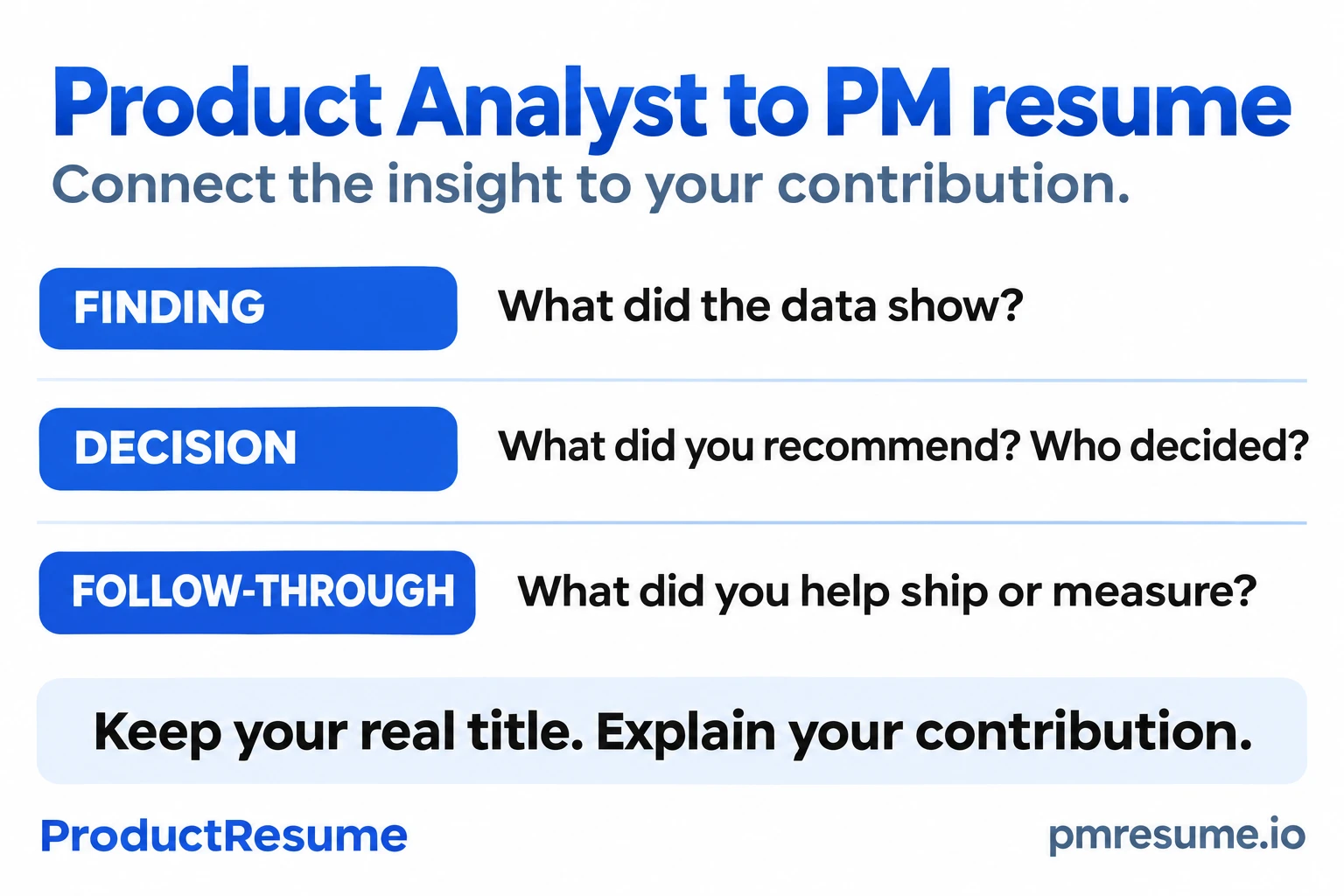
A product analyst to product manager resume should explain how your analysis informed a product decision and what you personally contributed afterward. Start with a real project, give AI the notes, and check whether the rewrite preserves who recommended, decided, and implemented the change.
Keep your Product Analyst title. Your work can demonstrate relevant product thinking without changing the name of your previous job.
TL;DR: Connect an analytical finding to a recommendation, the actual decision, your delivery contribution, and the result you can support. Use the worked example and short prompt below. Where your role stopped at analysis, explain that contribution clearly and identify what experience you still need.
Show the path from analysis to a product decision
Choose a project where you can explain what someone did with the insight. A dashboard, query, or experiment can establish analytical craft. The next question is which decision it helped inform.
Recover these details from your existing notes, tickets, analysis documents, or release records:
| Part of the work | What to recover | What the resume can explain |
|---|---|---|
| Analysis | User workflow, metric definition, and finding | What you investigated and what the evidence showed |
| Recommendation | Proposed action and alternatives | What you recommended and why |
| Decision | Who chose the priority or approved the change | Your actual authority and influence |
| Follow-through | Your role in requirements, tracking, testing, or release | What you contributed beyond the readout |
| Result | Observation, period, population, and measurement method | What happened and how confidently you can explain it |
You do not need every element in every bullet. Across the project, give the reader enough information to understand your contribution.
For example, Razorpay's Product Manager II posting for merchant integrations describes customer understanding, prioritization, scope management, engineering collaboration, and launch work. An analytical finding can support some of those responsibilities; it does not establish all of them. Razorpay's role description, checked 11 November 2026.
Worked example: merchant onboarding at a payments product
The candidate, project, figures, and observations below are fictional. This is an editorial demonstration of resume writing, not a real applicant or a tested AI output.
Imagine these are a Product Analyst's rough notes:
Worked on an India-focused merchant payments product. Used SQL and funnel events to investigate document-upload failures. Support records described merchants submitting unsupported file formats.
Recommended explaining accepted formats before upload rather than starting with reminder nudges. The PM chose the upload-guidance change after discussion with design and engineering. The designer wrote the interface copy and engineering built it.
I checked the event definitions and tracking after release. For each weekly cohort, I measured whether a merchant account submitted the required documents within seven days of entering the upload step.
Completion was 100 of 250 accounts in the earlier cohort and 120 of 250 in the later cohort. Acquisition-channel mix changed too. We did not run a randomized comparison.
These notes show analysis, a recommendation, a priority decision by someone else, and measurement work after release.
A vague starting version
Built onboarding dashboards and collaborated with product teams to improve conversion.
The sentence leaves the reader to guess what was found, which decision followed, and what “improve” means.
An illustrative resume section
Product Analyst | Merchant payments platform
- Investigated merchant document-upload failures using SQL, funnel events, and support records; recommended upfront file-format guidance, which the PM prioritized ahead of reminder nudges.
- Validated release tracking and measured seven-day document submission at 40% before and 48% after the change, across 250 accounts per cohort; noted acquisition-mix changes when interpreting the result.
The first bullet makes the recommendation and decision boundary visible. The second shows measurement craft and preserves the limits of the comparison.
If your own role stopped at delivering the analysis, do not copy the release-tracking work. Keep the finding and recommendation you can explain. If you personally owned prioritization, describe that responsibility with the actual decision and context.
Check the result before accepting the rewrite
The later cohort had higher observed completion. The notes do not isolate the cause. The acquisition mix changed, and the comparison was not randomized.
| Question | Answer from the fictional notes |
|---|---|
| What was measured? | Accounts submitting required documents within seven days of entering the upload step |
| What were the denominators? | 250 accounts in each cohort |
| What were the observed rates? | 100 ÷ 250 = 40%; 120 ÷ 250 = 48% |
| Who prioritized the change? | The PM, following the analyst's recommendation and team discussion |
| What remains uncertain? | How much of the difference came from upload guidance versus other changes |
A draft saying “Owned onboarding strategy and drove an eight-point conversion lift” would exceed these notes in two ways. It would change the writer's decision authority and attribute the full difference to their work.
You can describe an observed result without turning it into a causal claim. Keep the measurement definition available for interview follow-ups.
How to choose the right analyst work for a PM application
Lead with relevant work you can explain from problem through consequence. That may be a narrow initiative inside your current analyst role.
Consider three possible projects:
- A recurring dashboard: Explain the decision it supported. If no decision followed, describe its actual reporting value and responsibility.
- An experiment readout: Explain your role in the question, design, analysis, and recommendation. Participation in the analysis does not automatically establish ownership of the experiment.
- A product change informed by your analysis: Explain the finding, the alternative considered, the person who decided, and your follow-through.
Keep useful technical detail. SQL can show how you investigated a problem; event validation can show why the team could trust a readout. Give that detail a user or product context.
A senior analyst may have already owned substantial prioritization, instrumentation, or experimentation work. Surface that actual scope. An early-career analyst may have a useful recommendation and a small release contribution. Describe the work available rather than adding a senior-sounding label.
A real analyst transition example: product evidence can be buried
Look beyond the most technical description of your latest role. In ProductResume's anonymized analyst teardown, deployed analytical work dominated the recent experience, while earlier requirements and workflow work supplied additional product evidence.
The source does not justify assuming that the analyst owned every related product decision. Its useful lesson is to make the relevant contribution easier to find, then clarify what the person actually did.
For your own resume, ask:
- Did you identify a user or operational problem, or receive an already defined analysis request?
- Did you recommend an action, choose it, or provide evidence for someone else's decision?
- Did you help define what to build, validate the release, or only measure it afterward?
Keep the answers separate. A recommendation can be valuable without being final authority. A deployed model or dashboard can be useful without proving improved business outcomes.
Match the role before rewriting your title or summary
Read the actual responsibilities and experience requirements. PM roles with similar titles can ask for different work.
Another Razorpay Product Manager II posting, for international payments, explicitly asks for five to six years of PM experience and at least one year in payments or related financial infrastructure. It also asks for direct experience building external relationships through to a launch or deal. That is a specific requirement, not something a resume rewrite can supply. Read that role's requirements.
Use a target posting to sort your evidence:
- Supported: You have performed the responsibility and can explain your contribution.
- Relevant but partial: Your analysis informed the work, while another person owned the decision or delivery.
- Missing: You have no example yet.
A short summary is useful when it helps explain the transition. For the fictional candidate, it could be:
Product analyst with merchant-onboarding experience, combining funnel analysis, product recommendations, and release measurement. Seeking a PM role where I can take responsibility for problem selection and delivery.
This states the next responsibility the person wants. The experience section still needs to show what they have done so far. Keep historical job titles unchanged.
Use this short AI prompt with your existing resume
Start with your resume, a target JD, and rough project notes. Remove private or confidential information before sharing them.
Adapt my product analyst experience for this PM role. Ask what I personally analyzed, recommended, decided, and helped implement, then revise using only supported facts. Preserve my titles, team contributions, measurement context, and project stage. Flag ownership gaps rather than filling them in. Resume, notes, and JD: [paste].
Before using the output, compare it with the worked example:
- Actors: Did the PM's decision become yours?
- Method: Did a dashboard become user research or an observational comparison become an experiment?
- Result: Are the metric, denominator, period, and attribution accurate?
- Stage: Did a recommendation become a release?
- Relevance: Does the revised text address responsibilities in this particular JD?
You should be able to answer a follow-up about every claim.
If ownership is still missing, choose a real next step
Use the gap to plan experience you can actually gain. Rewriting alone cannot supply responsibility you have not held.
Within your current team, discuss a bounded opportunity such as proposing alternatives for one onboarding problem, helping define acceptance criteria, or following a change through release and measurement. Agree with the PM on what you will own and what remains theirs.
If the team is not making the proposed change, you can still write up the analysis and recommendation. Label any proposed solution or future measurement plan clearly. Keep learning work separate from delivered outcomes.
Turn the evidence into a reviewed resume
Bring your relevant analytical and product work into view. ProductResume's Resume Score identifies priorities in the evidence on your resume. Fix with AI uses that feedback to revise it, and you review the changes against your actual contribution before applying. See the complete resume improvement workflow.
Related resources
- Business Analyst to Product Manager resume and job search covers the broader move from requirements and delivery work.
- Product Manager resume examples by level helps you compare scope and decision authority.
- PM portfolio case-study template expands one analytical project into a fuller explanation.