Product Manager Behavioral Interview Questions: Build a Story Bank
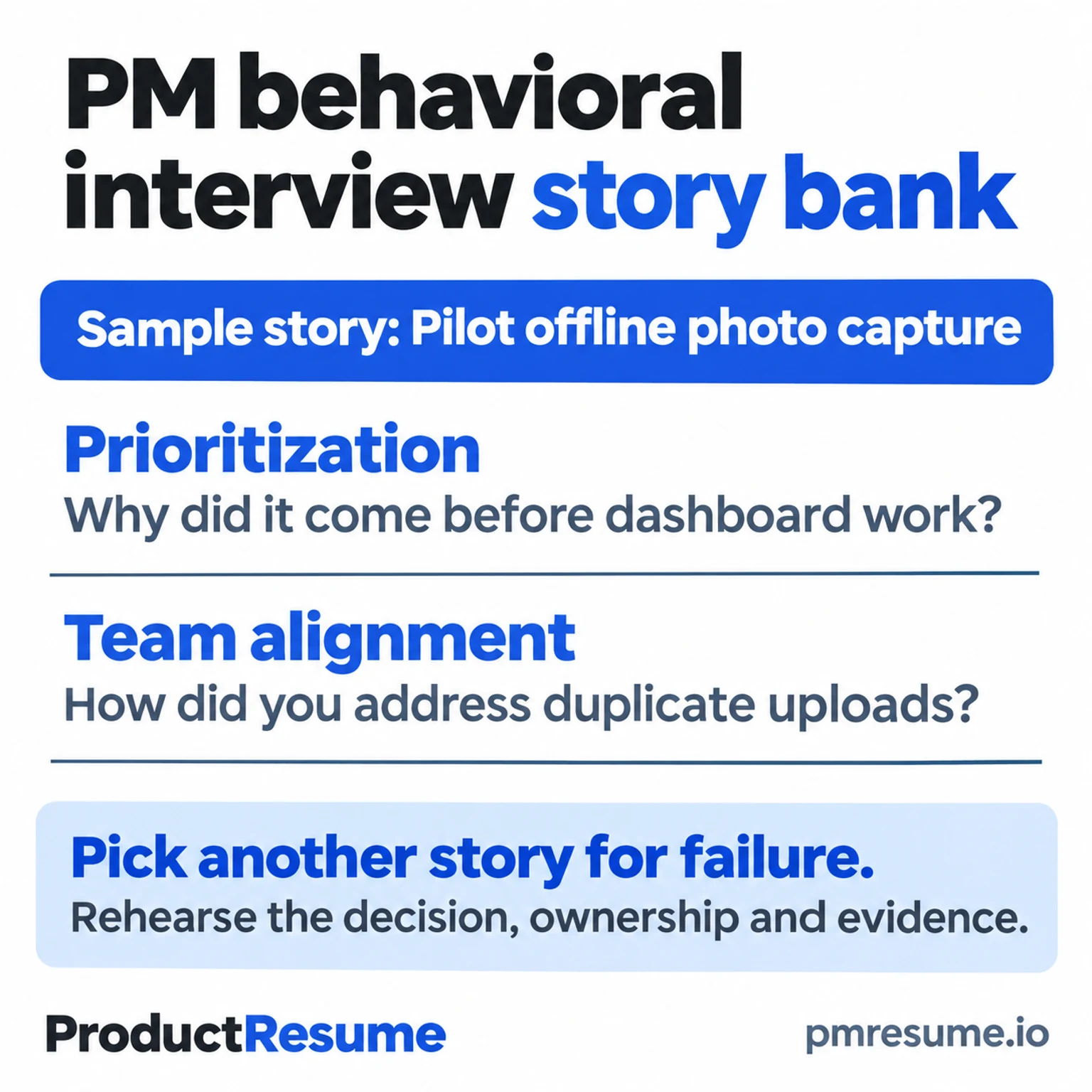
Prepare for Product Manager behavioral interview questions by making a small bank of real episodes you can explain from several angles. Pick one project from your resume today. Write down the decision, your part in it, the observed result, and the hardest follow-up you can answer. Then mark the questions that episode can actually support.
TL;DR: Build each story around a real decision and its consequences. Label the questions it can answer and one it cannot. Practice going from your resume bullet to the reasoning, responsibilities, and limits of the result.
Map questions to the work they ask you to explain
A useful story solves the interviewer's specific question. A cross-team launch can be a good example of delivery. It becomes a disagreement story when you can describe what people disagreed about and how it was resolved.
Use these practice questions to look for evidence in your own work. They are examples for rehearsal. The target role and recruiter guidance should determine where you spend the most time.
| Practice question | Evidence to look for |
|---|---|
| Tell me about a time you had to choose between competing priorities. | Two viable options, a constraint, and what you chose or recommended |
| Tell me about a time you got teams to agree on a difficult plan. | The teams' different concerns, your actions, and what people agreed to do |
| Tell me about a product choice that did not work as expected. | Your part in the choice, an observed consequence, and what you changed afterward |
| Tell me about a time customer evidence changed your plan. | The original plan, the evidence that challenged it, and the resulting decision |
| Tell me about an outcome you helped improve. | What was measured, the comparison, your contribution, and alternative explanations |
Amazon's PM interview guide describes questions about past experiences and the reasons behind decisions. Atlassian's PM interview handbook discusses outcomes, prioritization, and communication. Each describes its own process. Use them to see why a specific choice and an explainable result are worth preparing.
Create one story card for each useful episode
Start with three episodes from work, an internship, a project, or a student organization. Add more when a question you care about lacks a suitable example. These numbers are a starting point for practice.
For each episode, write a one-line cue that will help you remember it. Then capture:
- Problem and stakes. Who was affected, and what was difficult about the decision?
- Choice and evidence. Which options were on the table, and what guided the choice?
- Your part. What did you propose, decide, deliver, or measure? Who else did what?
- Outcome and limits. What happened, how do you know, and what remains uncertain?
- Question fit. Which prompts can this episode answer? When would you pick another story?
A student can use a prototype test with a clear design decision and a specific lesson. A career switcher can discuss a recommendation and its effect on someone else's decision. An experienced PM can explain a consequential trade-off across teams and what happened afterward. The episode should make the relevant contribution easy to understand.
Worked story card: choose offline capture first
The team and figures in this example are fictional. A PM works on a delivery app. Support reports show that drivers sometimes cannot record proof of delivery where reception is weak. The team has one sprint and two options on the table: improve the dispatch dashboard or pilot offline photo capture. Engineering points out that forwarding queued photos automatically could create duplicate uploads. Dispatch wants to know which deliveries still need evidence.
The PM uses support reports to recommend offline capture for the pilot. They propose a visible pending-upload state and agree on a manual retry with engineering and dispatch. Engineering implements the flow and monitors duplicate uploads. Dispatch helps select the pilot routes. The PM checks whether a delivery record exists by the end of the driver's shift.
| Question | What to feature in the answer |
|---|---|
| What did you prioritize with limited capacity? | Offline capture ahead of dashboard work, based on drivers' immediate difficulty recording delivery. Explain the one-sprint constraint. |
| How did you align teams with different concerns? | Engineering raised duplicate-upload risk. Dispatch wanted visibility into missing proof. A pending state and manual retry addressed those specific concerns for the pilot. |
| Tell me about a decision that failed. | Choose another episode. These notes describe a trade-off and a pilot, with no failed decision or corrective action to explain. |
A possible first answer to the prioritization question
We had one sprint to address evidence missing from delivery records. Drivers were reporting gaps in reception, and the team was also considering dashboard work. I recommended piloting offline photo capture first because it addressed what drivers could do at the point of delivery. Engineering flagged duplicate uploads, so we agreed with dispatch to show a pending state and ask drivers to retry manually. We checked how many deliveries had evidence by the end of the shift.
The alignment answer can use the same event. Lead with the two teams' concerns, then explain how the PM helped them agree on a narrower pilot. That opening answers a different question using the same facts.
Practice the resume claim three levels deep
Take a line from the resume you sent and ask increasingly specific questions about it. In the fictional example, the line is “Piloted offline proof of delivery with engineering and dispatch.”
- Clarify the claim. “What happened in the pilot, and what did you own?” The PM recommended the pilot, proposed the pending state, and defined the check. Engineering implemented the flow, and dispatch helped select the routes.
- Probe the decision. “Why did you choose a manual retry?” The team wanted to test whether drivers could capture a photo offline while limiting the duplicate-upload risk engineering identified. A manual step added work for the driver, so it remained a pilot trade-off.
- Check the evidence. “How do you know the change helped?” The comparison was 80 of 100 deliveries with evidence by shift end before the pilot and 90 of 100 during it. That's 80% versus 90%, a difference of 10 percentage points. Route mix changed. The later figure was higher, and the comparison alone can't isolate the effect of the feature.
A follow-up question is a good place to explain detail you left out of your first answer. See how to answer PM interview questions conversationally for a practice exercise on adjusting depth.
Turn your own notes into practice questions
Paste your resume, the role description, and rough notes about a few episodes. Remove sensitive information. Use the prompt to get a compact story bank you can practice aloud.
Build a PM behavioral story bank from my resume, notes, and target role. For each story, name the decision, my contribution, the observed result, and two questions it can answer. Flag each unsupported detail or weak fit. Then ask one resume follow-up at a time about ownership, reasoning, or evidence. Inputs: [paste].
Check every card against your notes. If one card claims you owned a decision made by someone else, revise it to show your contribution. If a new result appears, verify it or remove it. Try answering an unexpected question. Prefer a different episode when your bank already has a cleaner fit.
Rehearse with your target role in mind
ProductResume's Interview Prep uses your resume and the job description to create practice questions and preparation material. Use the questions to select a story, say your answer aloud, then go one level deeper on the decision or outcome.